
A Father’s Confession, A Son’s Refusal: Why “The Weight I Left Him” Is the Rare Redemption Story That Refuses to Redeem Itself
The Weight I Left Him is a raw redemption story about forgiveness, resilience, and refusing to let inherited hardship define your future.
Every year, the “inspiring true story” section fills with rags to riches memoirs promising a lesson worth remembering. Most deliver a highlight reel, a few motivational lines, and a brief emotional rush. Kenneth Carnesi, Sr.’s The Weight I Left Him refuses to be that kind of book. For more than 150 pages, it keeps that promise, making it an unusually honest and useful entry in the memoir meets self help genre.
The premise is simple but devastating: a father openly confronts how he failed his son financially, emotionally, and practically, then hands the story to the son who built two companies despite it. With no capital, mentor, or family safety net, the son built a managed Wi Fi company, then launched a cybersecurity firm that earned credibility in a credential driven industry. On paper, it is an underdog business story. What makes The Weight I Left Him different is that it makes you confront the pain behind the success before celebrating the outcome.
That refusal is the book’s backbone and what sets it apart. Carnesi does not begin with success. He begins with a blunt confession, detailing financial instability, broken promises, and more than seven years in which his son largely faced life’s challenges alone. He also confronts the family narrative that his failures had already determined his son’s future. Carnesi offers no excuses or softened version of events. The discomfort is intentional. You cannot fully understand what his son built, the book argues, until you understand what he had to build it against.
From there, the book blends raw personal storytelling with structured, workbook-style self-help. It explores family labels, the skills hardship can forge, imperfect but enduring love, the risks of building two companies from nothing, and the loneliness of carrying a family’s expectations. Each chapter ends with “Putting It Into Practice,” offering exercises that help readers examine the labels they carry, where they came from, and how they can shape what happens next.
It would be easy for that structure to feel gimmicky, a memoir dressed up with workbook prompts to justify a higher price point. It doesn’t read that way. The exercises are specific enough and grounded enough in what just happened in the chapter that they feel less like an add-on and more like the author refusing to let you off the hook the same way he refuses to let himself off the hook. This is not a book interested in making you feel inspired for ten minutes. It wants something from you by the last page, and it says so, plainly, more than once.
The chapter on forgiveness is where the book earns its keep, especially for readers wary of self help advice that treats forgiveness as pretending nothing happened. Carnesi sharply distinguishes forgiving from excusing. Forgiveness, he argues, does not require an apology or erase the harm. It simply stops giving the past power over your present. As he writes, “Forgiveness isn’t a gift you give to the person who hurt you. It’s a weight you set down so your hands are free to build what comes next.” The idea feels practical rather than sentimental, especially because Carnesi admits his son’s forgiveness was messy, nonlinear, and still ongoing.
That refusal of a tidy ending is, frankly, the book’s boldest and most trustworthy move. Carnesi tells the reader outright in the introduction that there is no movie-style reconciliation waiting at the end of this book, and he holds to it. The final chapter, an actual letter from father to son that closes out the narrative, is unguarded and moving precisely because it doesn’t try to resolve everything. Carnesi writes about watching his son build two companies with a clarity that never lets him take credit for it: “The pride I feel is the pride of a witness. Not a contributor. You built this. You.” It’s a hard sentence for any father to write, and it lands because the entire book has earned the right to write it.
Structurally, the book occasionally uses composite, hypothetical figures, such as a 38-year-old named Daniel and a 12-year-old named Eli, to broaden its themes beyond the author’s family. Clearly labeled as illustrative, these sections connect the family’s story to readers who have faced financial instability, limiting expectations, or complicated relationships with parents. For those readers, the detours serve as a bridge between one family’s experience and their own.
The book’s later chapters earn their place rather than coasting on the momentum of the earlier ones. “The Grit Blueprint” distills the principles scattered through the narrative into something closer to a usable set of operating rules, while “The Cost of Winning” is the section most business memoirs skip entirely: an honest account of what it actually feels like to outpace the people who raised you, the specific, disorienting guilt of succeeding in a world that looks nothing like the one you came from, and the grief that can sit right next to pride without either one canceling the other out. Carnesi doesn’t resolve that tension so much as give the reader permission to hold it, which is consistent with everything the book has done up to that point. Few books about entrepreneurial success are willing to admit that winning has a cost at all, let alone spend an entire chapter naming it.
It’s worth being clear-eyed about what kind of book this is, because it will find its truest audience among readers who know exactly what they’re looking for. This is not a polished business memoir with charts and growth metrics; readers hoping for a granular account of building a managed Wi-Fi company and a cybersecurity firm will get context and texture rather than a founder’s playbook. Instead, it is a psychological and emotional account of what it costs, and what it can build, to grow up carrying someone else’s failure. What it takes to set that weight down without pretending it was never there. The prose is direct, unadorned, and occasionally repetitive in the way that hammering home a hard truth over 150 pages requires; Carnesi circles back to his central thesis: “your starting point is not your ending point”, often enough that it becomes less a phrase and more a mantra the book is training you to carry out the door with you.
That repetition is a deliberate choice rather than a flaw, and it’s consistent with the book’s larger honesty about itself. This is a book that tells you exactly what it is doing while it does it, chapter after chapter, and somehow that transparency never undercuts its emotional force. If anything, it deepens it. You believe the confession because the author never asks you to take it on faith; he shows you the receipts, one specific failure at a time, and lets the reader decide whether the redemption that follows has been earned.
“The Weight I Left Him” doesn’t ask to be admired from a distance. It asks the reader to do something with it. Whether or not you pick up the pen it keeps handing you, the story it tells of a father’s unflinching accounting and a son’s quiet, ferocious refusal to be defined by it, will stay with you well past the last page.
It is rare for a book to be this hard on its own author and this generous toward its reader at the same time. Carnesi spends more pages indicting himself than praising his son, and yet the net effect isn’t bleak. It’s clarifying. By the time the letter arrives in the final chapter, the reader has been given not just a moving family story but a working vocabulary for their own: for the weight they didn’t choose, the verdict they didn’t earn, and the quiet decision, available right now, to write past both.
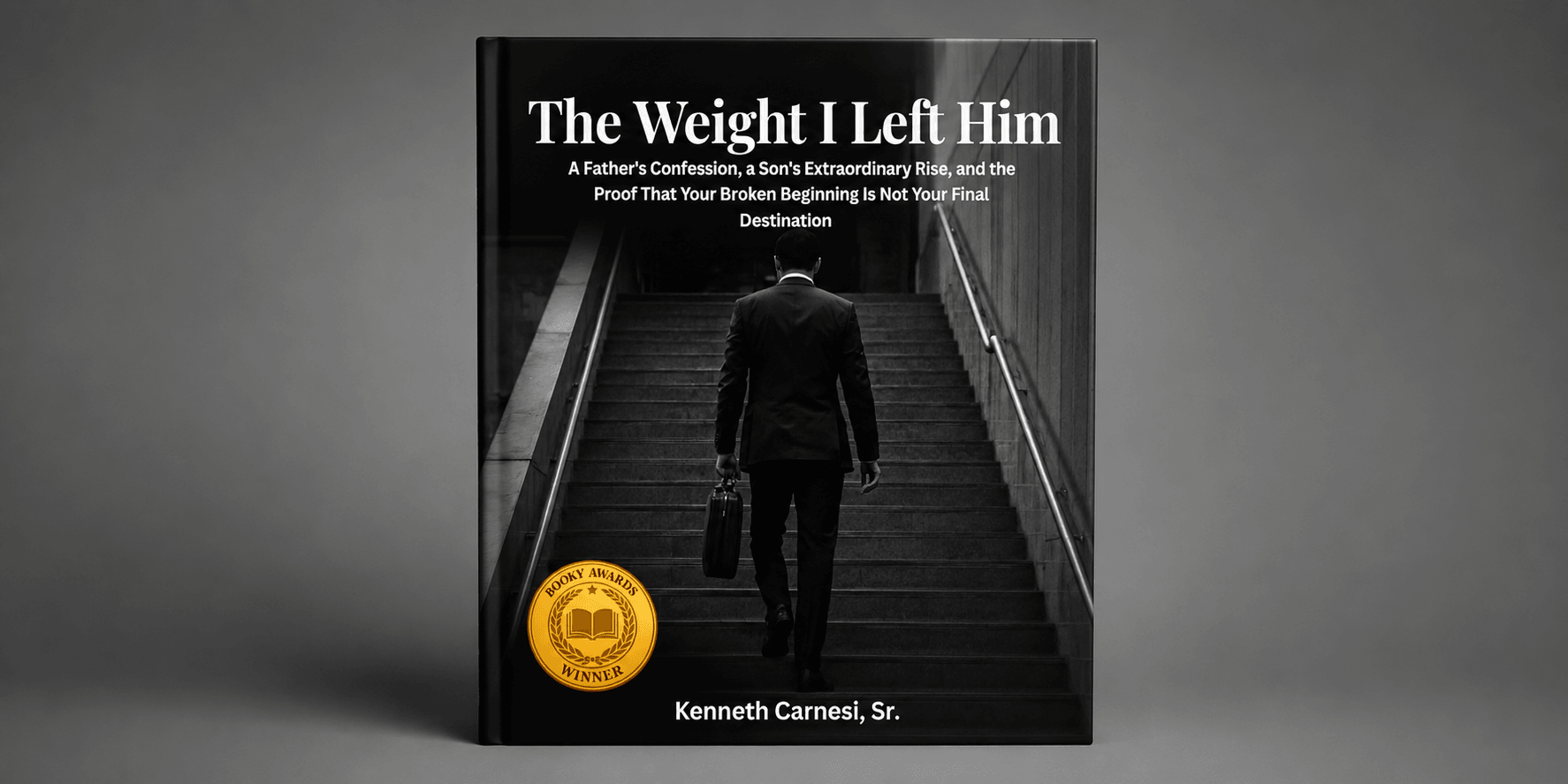
As a Winner of a 2026 Booky Award for Best Treatment of Forgiveness in a Non-Fiction, Inspirational Book genre, The Weight I Left Him , earns its keep.
To learn more about Kenneth Carnesi, Sr., visit KennethCarnesiAuthor.com, explore his books at Books.by/Kenneth-Carnesi-Sr, and connect with him on Instagram and LinkedIn.

Today’s Read Contributor
Eleanor Voss
Covers fiction and criticism, reviewing new novels and the writers shaping contemporary storytelling.
This article features partner, contributor, or branded content from a third party. Members of the Today’s Read editorial staff were not involved in the creation of this content. All views and opinions are those of the contributor alone.