 Today's Read Contributor
 New survey data from Sudoku-Guru.com reveals that most players use Sudoku not for brain training, but for focus and calm.
When A Puzzle Becomes A Daily Escape
In a world where attention is constantly pulled in every direction, even small moments of focus have become valuable. Notifications compete for attention, social feeds refresh endlessly, and the simple act of concentrating on one task can feel surprisingly difficult.
For many people, the solution has not come from productivity apps or meditation tools. Instead, it comes from a familiar grid of numbers.
According to the Cognitive and Emotional Effects on Players: Sudoku Guru 2026 Report, released by Sudoku-Guru.com, Sudoku has quietly evolved into something more than a puzzle. Based on responses from 9,470 players across three stages of play, the report reveals that most players are not turning to Sudoku primarily to boost intelligence or memory. They are using it to reclaim focus and create a brief pocket of calm in a crowded digital landscape.
Readers can explore the platform and puzzles directly at https://Sudoku-Guru.com.
The findings challenge the popular narrative surrounding brain training apps. While many platforms promise measurable cognitive improvement, Sudoku players appear to be pursuing something more practical: a reliable way to reset their attention during the day.
The Honest Truth About Memory
One of the most striking findings in the report concerns a question often used in marketing for brain games. Does Sudoku improve everyday memory?
The answer from the players was refreshingly honest.
When surveyed, 45 percent of participants said yes, while 48 percent said no. The remaining respondents were unsure. Instead of hiding the split result, the report presents it openly.
The explanation lies in the type of thinking Sudoku requires. The puzzle is less about recalling stored information and more about managing constraints and testing logical possibilities. Players hold multiple conditions in mind while gradually eliminating incorrect options.
That process strengthens reasoning and pattern recognition, but it does not necessarily translate to remembering where you left your phone or your car keys. Players appear to understand this distinction clearly, even if popular marketing around brain training sometimes blurs the line.
Focus Gains That Players Actually Notice
Where Sudoku does appear to make a measurable difference is in attention.
Among players who completed ten or more sessions, several patterns emerged. Fifty two percent reported better concentration when working on demanding tasks. Nearly half said switching between tasks felt easier. Another 47 percent noticed improvements in planning ahead.
These changes were not described as dramatic transformations. Instead, players reported subtle but meaningful improvements in their daily routines. The difference becomes noticeable when sitting down to work, reading, or tackling complex tasks.
Many players described Sudoku as a ten to fifteen minute mental warm up before beginning focused work. Just as athletes stretch before physical activity, puzzle solving prepares the brain for sustained attention.
Stress Relief: The Benefit Players Value Most
Perhaps the most revealing discovery in the survey was the reason people choose to play.
When asked why they open the app, 62 percent of players said they play to relax. Brain training ranked slightly lower at 58 percent.
Several open ended responses offered an even clearer picture. Some players wrote that they open the puzzle instead of scrolling through social media. Others said they play before going to sleep or during their commute when they want a break from work related thoughts.
Session data reinforced the same pattern. While solving a puzzle, players rated their stress at 2.6 out of 5, indicating mild but manageable tension. After completing the puzzle, their reported calm increased to 3.7 out of 5.
The improvement happens within a single session that typically lasts fifteen minutes. The puzzle demands enough concentration to block out distractions without overwhelming the player.
Founder Evgeny Stakhov says the results changed how the team viewed their own product.
“The stress relief findings caught us off guard. It turned out that for the majority of our players, focus and calm matter more than cognitive gains. That changes how we think about the product.”
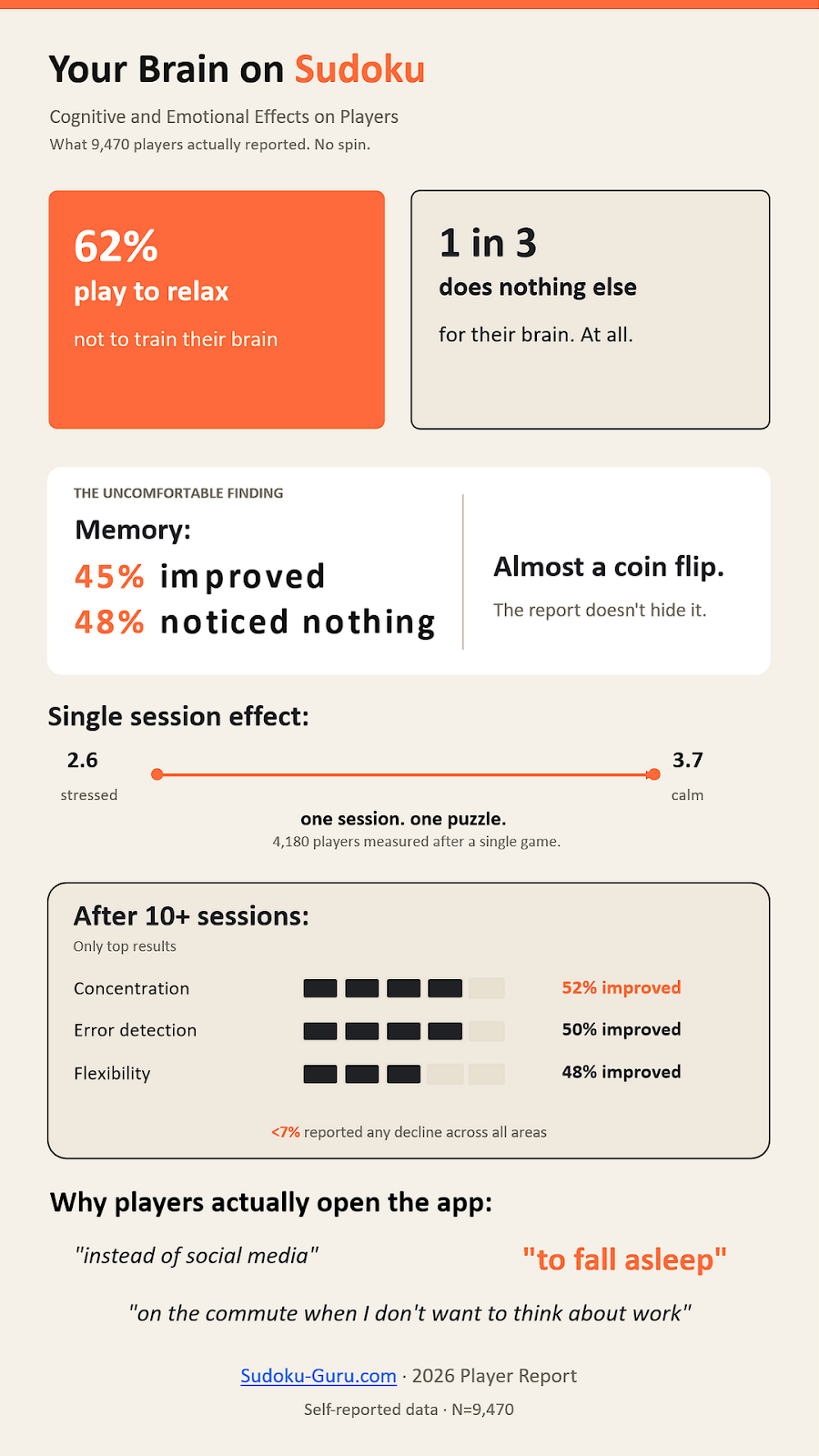 Photo Credit: BARS Agency
A Community Built On Consistency
Another insight from the report highlights the dedication of Sudoku players themselves.
For nearly one third of respondents, Sudoku is the only structured mental activity they practice regularly. They do not play chess, complete crossword puzzles, or use other brain training apps.
Many simply solve one puzzle each day.
Nearly half of the community is aged fifty five or older, and for many of them the morning puzzle has replaced the daily newspaper. It is a quiet ritual that engages both hands and mind before the day begins.
Over time, this consistent practice appears to produce steady results. Fewer than seven percent of surveyed players reported cognitive decline across the six measured areas. Most reported small improvements, while some noticed no major changes.
Almost none reported negative effects.
What The Most Consistent Players Do Differently
The report also examined the habits of players who experienced the strongest improvements in focus. From their behavior, researchers identified several practical patterns.
Daily play matters more than long sessions. Players who spent ten to twenty minutes each day showed stronger results than those who played for hours occasionally.
Difficulty also played a role. Players who gradually moved from beginner puzzles toward harder levels reported more benefits than those who stayed with easy grids.
Timing made a difference as well. Players who solved a puzzle before starting focused work often found it easier to concentrate afterward.
Finally, many players described replacing short bursts of social media scrolling with puzzle solving. The contrast was noticeable. Passive content often left them feeling scattered, while Sudoku created a sense of calm concentration.
A Simple Puzzle With A Modern Purpose
Sudoku has existed for decades, yet its role in everyday life appears to be changing. What was once simply a newspaper pastime has become a tool for managing attention in an increasingly distracted world.
Platforms such as https://Sudoku-Guru.com now serve a global community of players who use the puzzle not only for entertainment but also for mental clarity. With more than 200,000 active users worldwide, the platform emphasizes distraction free design and progressively challenging puzzles that encourage active thinking.
For many players, the appeal of Sudoku lies in its simplicity. There are no notifications, no endless feeds, and no algorithm deciding what comes next. There is only a grid, a set of rules, and the quiet satisfaction of solving a problem step by step.
The full Cognitive and Emotional Effects on Players: Sudoku Guru 2026 Report, including detailed methodology, demographic breakdowns, and complete findings, can be accessed at:
https://sudoku-guru.com/info/research-2026/