
The Software Rally Wasn’t About Software
By Lolita Trachtengerts, Growth & GTM Ops, Spotlight.ai
May was the best month for software stocks since 2001. The market wasn’t betting that AI spares SaaS. It was betting on who owns the ground an agent stands on.
For most of 2026, the smart money had a name for what AI would do to software: the SaaSpocalypse. Agents would do the work, seats would empty out, and the per-user subscription would die quietly.
Then May happened. Software stocks posted their best month since 2001. So everyone relaxed. The takeaway wrote itself: AI won’t kill SaaS after all. That is the wrong lesson. Look at what the market actually bought.
Snowflake reported $1.39 billion in quarterly revenue, up about 33%, raised its guidance, signed a $6 billion deal with AWS, and bought a startup that governs agent workflows. The stock jumped 36% in a single day, its best day ever. Okta rose a record 30% in an afternoon because agents need identity and someone has to police a flood of bots. ServiceNow clawed back about a third of its losses on the argument that agents need orchestration, approvals, and an audit trail.
Salesforce beat estimates too. The stock barely moved. Here is the thing. The winners and the laggard sell very different products. Snowflake, Okta, and ServiceNow sell the ground an agent stands on: clean data, identity, control. Salesforce mostly sells seats. When an agent does part of a rep’s job, you don’t buy it a seat. You remove a human one.
The market worked out the real rule before most of us said it out loud. An agent is only as good as the layer underneath it. Snowflake’s CEO went ahead and called his company “the control plane for the agentic enterprise.” He has the shape of it right. So the question for any company shipping an AI agent this year is not whether you can build one. Everyone can build an agent now.
The question is what it stands on. This is where revenue teams are about to get an expensive lesson.
Point an agent at your CRM and ask it to run a deal. It will answer in full sentences, instantly, with total confidence. It will also be wrong a lot of the time. Not because the model is weak. Because the CRM is a filing cabinet, not a brain. It holds what a rep typed, when the rep felt like typing it. Stages that mean different things to different people. Notes that blend evidence with hope.
Feed that to an agent and you get a fast, fluent hallucination. “Deep integration” became the phrase of the quarter. Most people use it to mean plugging an agent into Salesforce. That is not deep. That is a straw into the same murky glass.
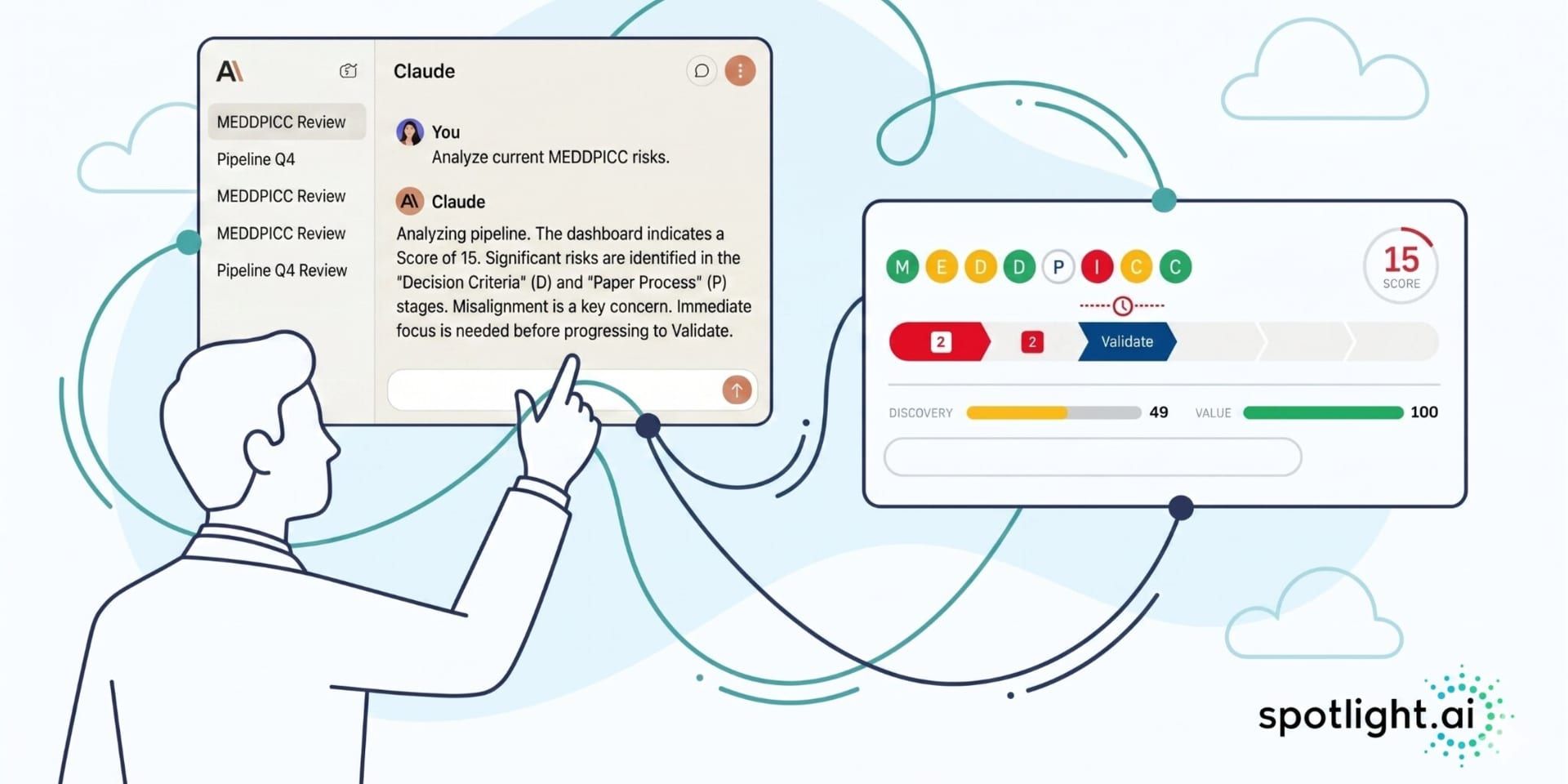
Deep means giving the agent a layer that understands the work. What a champion looks like versus a coach. What a real economic buyer sounds like on a call. How deals in your industry get won and lost, and which signals matter versus which are noise. A methodology like MEDDICC stops being a set of fields to fill in and becomes something the system can reason about.
At Spotlight we built that layer and call it the Knowledge Graph. It sits on more than $8 billion in managed opportunities, and it exists for one reason. Agents that stand on raw data hallucinate, drift, and lose the room. Agents that stand on structured sales knowledge do not.
We opened it up over MCP this year, so teams can build their own agents on top of it instead of starting from a blank model and hoping. The proof is boring, which is how you know it is real.
In one 300-user deployment, conversion moved from 7.8% to 12.5%. That is $5.9 million in impact and about 4,530 workdays nobody had to spend updating records. The agent did not perform because it was clever. It performed because it had something solid under it.
That is the story of May, compressed. The market did not reward AI. It rewarded substrate. Data, identity, orchestration, the unglamorous plumbing that lets an autonomous system act without making things up.
For revenue, that substrate is a sales brain. Not another dashboard, and not another seat. The teams that understand this will run their pipeline with a system that decides and acts. The ones that bolt an agent onto a filing cabinet will get a very confident intern who has never closed a deal.
The rally priced in the first half of that idea. The next few quarters will price in the second.
Learn more at Spotlight.ai Website or follow updates on LinkedIn, Twitter, Facebook and Instagram.

Today’s Read Contributor
Desmond Clarke
Covers the publishing industry and narrative nonfiction, from acquisitions and imprints to the biographies readers are talking about.
This article features partner, contributor, or branded content from a third party. Members of the Today’s Read editorial staff were not involved in the creation of this content. All views and opinions are those of the contributor alone.