
August 12, 2026 Solar Eclipse Gives Parts of the United States a Rare Skywatching Experience
On August 12, 2026, people across parts of the United States had the opportunity to witness a partial solar eclipse as the Moon passed between Earth and the Sun. The astronomical event was part of a total solar eclipse that crossed several regions around the world, including Greenland, Iceland, northern Russia, Spain, and Portugal.
Although the United States was not within the path of totality, portions of the country experienced a partial eclipse. The event offered skywatchers an opportunity to observe the Moon temporarily covering part of the Sun and served as a reminder of the remarkable alignment between Earth, the Moon, and the Sun.
A Partial Eclipse Across the United States
The eclipse appeared differently depending on where people were located. Areas farther north generally experienced greater coverage than locations farther south and east.
In Alaska, communities including Fairbanks and Anchorage experienced some of the most noticeable portions of the eclipse visible from the United States. Parts of the northeastern United States also experienced the event, although the amount of the Sun covered by the Moon was smaller.
The timing varied by location as well. In some areas, the eclipse occurred during the morning, while observers farther east saw it during the afternoon. This meant that local viewing conditions depended on both geographic location and the position of the Sun in the sky.
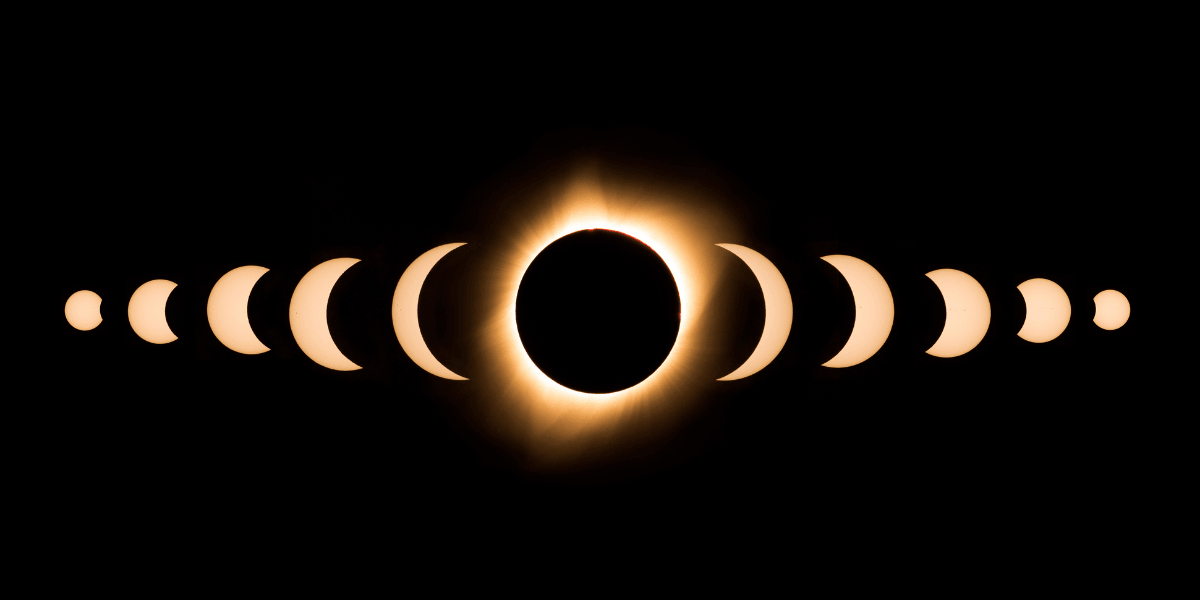
For observers outside the path of totality, the Moon never completely covered the Sun. Instead, the Moon appeared to move across part of the Sun’s bright disk, creating the characteristic crescent-like appearance associated with a partial solar eclipse.
How a Solar Eclipse Happens
A solar eclipse occurs when the Moon passes between Earth and the Sun and casts its shadow onto Earth’s surface. Because the Moon is much smaller than the Sun, a total eclipse is visible only from a relatively narrow portion of Earth.
During a total solar eclipse, the Moon can completely block the bright surface of the Sun for observers located within the path of totality. People outside that narrow path may instead see a partial eclipse, depending on how close they are to the central shadow.
The August 12 event was a total solar eclipse on a global scale, but viewers in the United States generally experienced only its partial phase. This difference illustrates how the same astronomical event can produce very different viewing experiences depending on location.
A Notable Event for Families and Skywatchers
Solar eclipses often attract attention from professional astronomers, amateur skywatchers, educators, photographers, and families. They provide an accessible way to observe a predictable astronomical event and learn more about the movement of objects within the solar system.
The August eclipse also offered an opportunity for educational activities. Schools, science organizations, and astronomy groups could use the event to explain concepts such as orbital motion, shadows, light, and the relative positions of Earth, the Moon, and the Sun.
For casual observers, the event did not require an understanding of advanced astronomy to appreciate. Simply watching the Moon gradually move across the Sun provided a visible demonstration of celestial motion.
Safe Viewing Remained Important
One of the most important considerations during any solar eclipse is eye safety. Looking directly at the Sun without appropriate protection can cause permanent eye damage, including during a partial eclipse.
Standard sunglasses are not designed to protect the eyes during direct solar viewing. Specialized solar-viewing glasses or approved solar viewers are necessary for direct observation.
Another option is indirect viewing. Simple projection techniques can allow people to observe the shape of the partially eclipsed Sun without looking directly at it.
The safety precautions are particularly important because the Sun remains extremely bright during a partial eclipse. Unlike during the brief period of totality in a total solar eclipse, the bright portion of the Sun remains visible throughout a partial eclipse.
Why the August Eclipse Matters
The August 12 eclipse was significant not because every part of the United States experienced a dramatic darkening of the sky, but because it provided another opportunity for people to observe a major astronomical event.
The eclipse also demonstrated the importance of location in astronomy. While some parts of the world experienced totality, observers in the United States saw varying degrees of partial coverage. The difference was determined by the path of the Moon’s shadow as it moved across Earth.
Events such as this can also encourage greater public interest in science. Solar eclipses are relatively easy for the public to understand visually, making them effective opportunities to introduce children and adults to astronomy and space science.
A Memorable Skywatching Event
The August 12, 2026 solar eclipse gave parts of the United States a chance to witness one of nature’s most recognizable astronomical phenomena. While the country did not experience totality, observers in several regions were able to watch the Moon pass across the Sun and temporarily reduce the amount of sunlight reaching Earth.
For those who viewed it safely, the event offered both entertainment and education. It highlighted the precise movements of celestial bodies and showed how an astronomical event can create different experiences for people thousands of miles apart.
The eclipse also served as a reminder that opportunities to observe the night and daytime sky continue throughout the year. With future solar and lunar eclipses already anticipated, skywatchers will have more chances to look upward and experience the science of astronomy firsthand.

Today’s Read Contributor
Harriet Nyong'o
Covers authors and their working lives, profiling the writers behind the year's most discussed books.
This article features partner, contributor, or branded content from a third party. Members of the Today’s Read editorial staff were not involved in the creation of this content. All views and opinions are those of the contributor alone.