
Alessandro Catorcini Completes The Shield Cycle, Bringing Ancient Rome’s Forgotten Voices To Life
Technology executive and novelist Alessandro Catorcini completes a trilogy exploring the overlooked soldiers and innovators who shaped Rome’s history.
History often remembers the generals, emperors, and celebrated victories. Yet behind every monument stands a far larger cast of people whose names disappeared long before the stone was carved. That quiet truth lies at the heart of Alessandro Catorcini’s completed Shield Cycle, a collection of three standalone historical novels that shifts the spotlight away from Rome’s celebrated heroes and toward the soldiers, engineers, and survivors whose lives rarely found a place in the historical record.
Born in Genoa, Italy, and now living in Bellevue, Washington, Catorcini balances a career as a technology executive with a lifelong passion for classical history. His studies of Latin and Greek first sparked a fascination with the ancient world, one that eventually evolved into a literary mission. Rather than retelling familiar stories, he explores the overlooked people who carried shields into battle, designed the machines that changed history, and survived events that later generations reduced to a few lines in history books.
The Shield Cycle Explores The Human Side Of Ancient Rome
The completed Shield Cycle consists of three independent novels that share a common idea rather than a continuous storyline. Each book can be enjoyed on its own while examining a different chapter of Roman history through the eyes of ordinary individuals whose contributions were anything but ordinary.
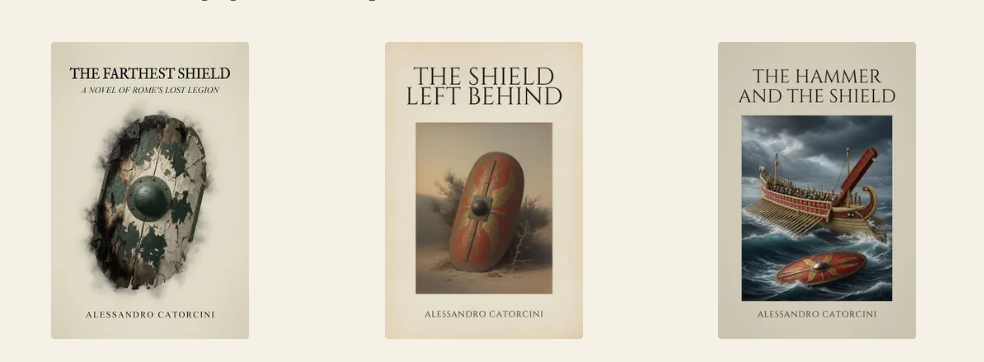
The newest novel, The Hammer and the Shield, takes readers into the First Punic War and centers on the invention of the corvus, the remarkable boarding bridge that transformed Roman naval warfare. Its protagonist, Manius Fabricius, is the disgraced second son of a Roman senator whose gift for engineering leads him to create a weapon capable of changing the balance of power between Rome and Carthage. Although history celebrates the victorious commanders, Fabricius discovers that recognition rarely belongs to the people whose ideas made victory possible. His story explores innovation, sacrifice, and the complicated relationship between achievement and remembrance.
The Shield Left Behind moves forward to one of Rome’s darkest military disasters at Cannae. Instead of focusing on famous commanders, the novel follows a survivor who abandons his shield during the battle and lives with the consequences for the next fourteen years. Through exile in Sicily, personal disgrace, and Rome’s eventual triumph over Hannibal at Zama, the story becomes a meditation on honor, identity, and redemption.
Completing the trilogy, The Farthest Shield imagines the extraordinary journey of one of the lost legionaries of Carrhae. After Rome’s devastating defeat in 53 BCE, its protagonist continues eastward across decades and continents until he reaches the frontier of Han China. Blending historical possibility with compelling fiction, the novel examines endurance, cultural encounters, and the meaning of belonging far from home.
A Different Perspective On Historical Fiction
What distinguishes the Shield Cycle is its commitment to examining history from below rather than above. While many historical novels revolve around emperors and military legends, Catorcini deliberately chooses characters who would have remained invisible to traditional chroniclers.
As he explains, “The monuments are always for the men who gave the orders. I’m interested in the ranker who lived through it and the maker whose name never got cut into the stone. Those are the people who actually built the world we inherited.”
That philosophy gives the novels an emotional depth that extends beyond military campaigns. Battles become deeply personal experiences. Engineering becomes an expression of character. Survival becomes just as meaningful as victory.
Writing Across Two Languages
Catorcini writes in both English and Italian, allowing readers in each language to experience the stories as complete works rather than collaborative translations. The Italian editions, including Il Martello e lo Scudo, are published independently with their own presentation while preserving the author’s distinctive voice.
This bilingual approach reflects the international perspective that has shaped both his life and career. Living between Italian heritage and American professional life provides a unique lens through which to revisit one of history’s most influential civilizations.
Engineering Curiosity Beyond Fiction
The same analytical mindset that informs Catorcini’s historical fiction also appears in his work outside the novels. Through his website, he maintains a public notebook documenting hardware projects, home infrastructure, and automation experiments. Readers interested in both historical storytelling and modern engineering can follow his observations about what he builds, what succeeds, what fails, and the lessons learned through each project.
That combination of technical precision and historical imagination gives his fiction a distinctive authenticity. The machines, logistics, and practical realities of the ancient world become as vivid as the characters themselves.
Discover The Shield Cycle
With the completion of The Shield Cycle, Alessandro Catorcini has created a collection of historical novels that invites readers to reconsider whose stories deserve to be remembered. By focusing on the soldiers who survived, the inventors who remained anonymous, and the ordinary people who quietly shaped extraordinary events, the trilogy offers a fresh perspective on ancient Rome that is both intellectually engaging and deeply human.
All three novels, The Hammer and the Shield, The Shield Left Behind, and The Farthest Shield, are available in English and Italian as paperback and ebook editions through Amazon and Google Play. Readers can learn more about the books, explore both language editions, and discover additional projects by visiting www.catorcini.com/books and www.catorcini.com.

Today’s Read Contributor
Harriet Nyong'o
Covers authors and their working lives, profiling the writers behind the year's most discussed books.
This article features partner, contributor, or branded content from a third party. Members of the Today’s Read editorial staff were not involved in the creation of this content. All views and opinions are those of the contributor alone.