
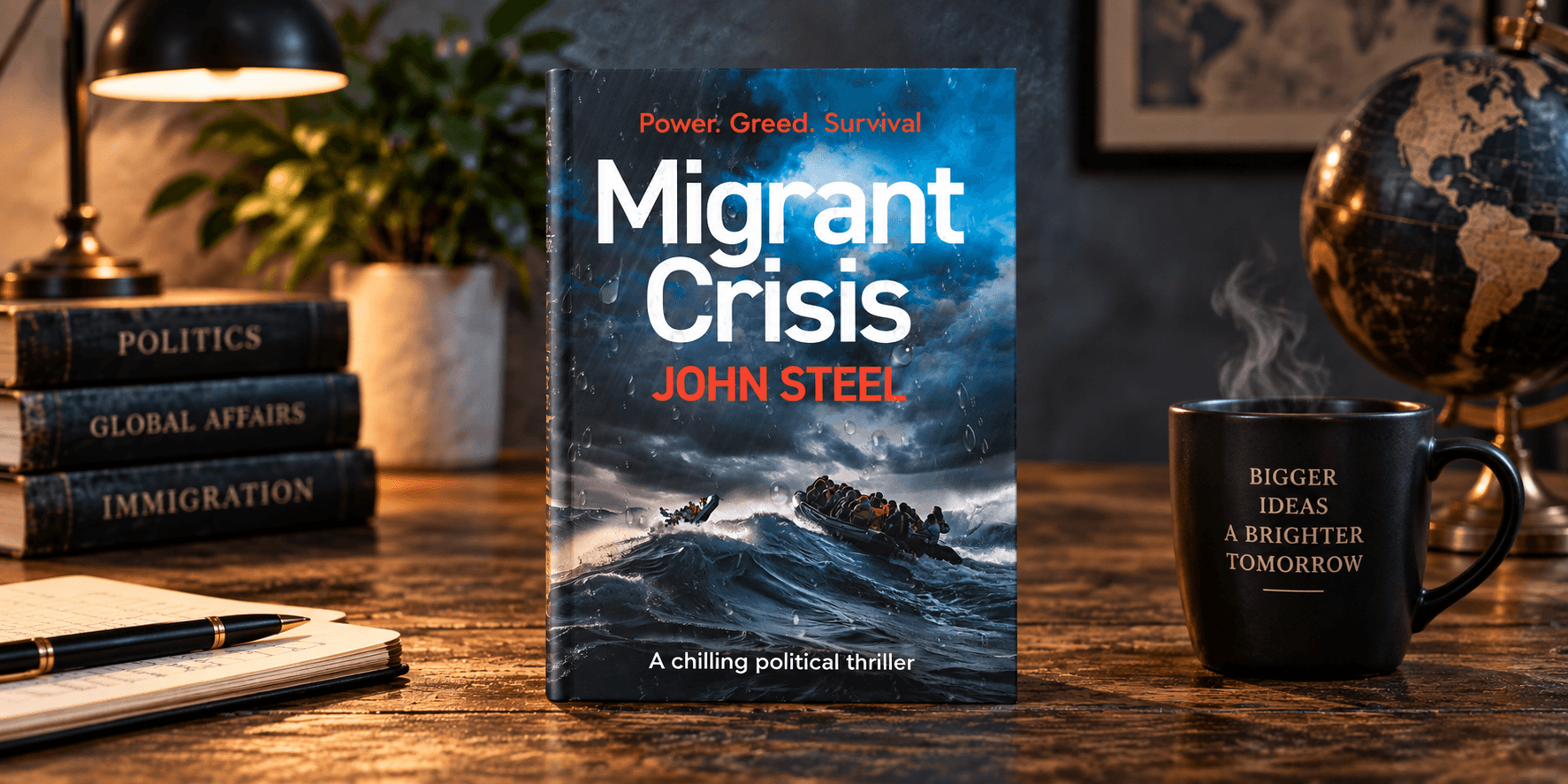
When Fiction Collides With Reality: John Steel’s Migrant Crisis And The Headlines That Followed
John Steel’s Migrant Crisis appeared first. Months later, events in the Channel crisis began to echo scenarios already on its pages.
Political thrillers work best when they make an imagined tomorrow feel uncomfortably possible. For John Steel, author of Migrant Crisis, that boundary between invention and reality has recently become unusually thin. Published on November 27, 2025, the novel explores a worsening Channel migration crisis, political pressure on Britain and France, changing tactics among people smugglers, public disorder, and the search for new forms of cross Channel cooperation. Then, during 2026, real events began producing striking echoes of situations Steel had already committed to the page.
The timing makes those echoes particularly striking. In March 2026, a five-star reviewer described Migrant Crisis as “the kind of novel that feels ripped from tomorrow’s headlines.” In June, another reader independently used almost exactly the same phrase. Then came September and a succession of developments that made those earlier reviews seem unexpectedly prescient.
The point is not that Migrant Crisis predicted the future. Political novelists do something subtler. They observe pressures already building, ask where those pressures might lead, and construct plausible consequences. What makes Steel’s novel intriguing today is how some of those imagined consequences have subsequently found parallels in the real political debate.
When The Map Begins To Change
One of the clearest examples appears on page 98 of Migrant Crisis. Under pressure, smuggling boss Dex Mullen studies the geography of his Channel operation and decides established routes can no longer be relied upon.
“We diversify launch sites. Not just Calais. Boulogne. Dunkirk. Maybe even the Belgian coast if we have to.”
The logic is simple. Apply pressure in one place and an adaptable criminal network searches for another.
Months after the novel appeared, events in September 2026 brought that idea into sharper focus. An unusually long Channel journey from the Normandy coast toward Portsmouth drew attention to whether smugglers might be looking farther west as enforcement made established routes more difficult.
The circumstances were not identical to Steel’s fictional scenario, nor do they need to be. What echoes is the underlying dynamic. The novel imagines smugglers reacting to enforcement not by abandoning their business, but by changing its geography.
That is one of the enduring concerns of political thrillers. A policy decision rarely produces only the intended result. It creates reactions, countermoves, and unintended consequences. The novelist’s task is to imagine what those might look like before they arrive in tomorrow’s news.
When Fiction Tests Its Own Boundaries
As the fictional government searches for a way to stop the Channel crossings, Downing Street considers a “rapid-return protocol” under which intercepted boats would be returned directly to France. The fundamental political obstacle is expressed with blunt simplicity:
“The French won’t take them back.”
Later, as the fictional crisis escalates, direct British-French negotiations produce an emergency accord, with British and French vessels cooperating more closely and intelligence being shared in real time.
Then, on September 4, 2026, Nigel Farage and Jordan Bardella signed a memorandum of understanding under which, if Reform UK and National Rally form governments, asylum seekers arriving in Britain from France would be returned to France, which would subsequently repatriate them. The agreement immediately generated political controversy in France.
The fictional government accord and the later party agreement are not the same arrangement, nor are they presented as such. What makes the parallel striking is the political obstacle at their centre: whether France would agree to accept migrants returned from Britain.
A problem stated in five words in Steel’s fiction had, months later, become the subject of an actual cross-Channel political agreement.
That is where political fiction can become particularly intriguing. Rather than predicting a precise policy, it can identify the pressure points around which future political choices may eventually have to be made.
When The Crisis Leaves The Water
The third parallel moves away from boats and diplomacy and onto British streets.
On page 19 of Migrant Crisis, National Security Adviser Maya Linford briefs the prime minister about rapidly spreading demonstrations.
“There are sixty two active protest locations as of seven this morning ... that’s up from twenty eight last Wednesday.”
In the novel, Channel migration has ceased to be solely a border management issue. It is becoming a public order crisis, placing additional pressure on the government and changing the political consequences of every decision.
In September 2026, demonstrations connected to migration disrupted the Port of Dover. The following day, hundreds of protesters gathered in Portsmouth after migrants from the Normandy crossing were brought toward the city. Roads were blocked, and the movement of migrants from Portsmouth was delayed.
Once again, the details differ. What parallels the novel is the progression.
A crisis that begins at sea moves inland. Border enforcement becomes public protest. Public protest becomes a policing issue. The policing issue increases political pressure. Each stage alters what governments can realistically do next.
That sequence is fertile territory for a political thriller because it reveals how apparently separate events can become part of the same chain.
The Chronology That Makes The Story Compelling
The timing gives these parallels their literary interest.
Migrant Crisis was published on November 27, 2025. On March 28, 2026, a five star reviewer described it as “the kind of novel that feels ripped from tomorrow’s headlines.” On June 18, Daniel Thompson independently used almost exactly the same phrase, writing that Steel had created “a thriller that feels ripped from tomorrow’s headlines.”
Then came September.
Between September 4 and 9 came the Farage–Bardella agreement addressing migrant returns, protests in Dover and Portsmouth, an extraordinary Normandy crossing, and political controversy in France surrounding the return of migrants.
After considering the similarities, Guardian immigration journalist Diane Taylor described the novel as sounding “very prescient.”
The temptation with a chronology like that is to reach for the language of prediction. But doing so arguably makes the story less interesting.
A stronger question is how fiction can arrive at a plausible destination before events do.
How Political Thrillers Get Ahead Of The News
The best political thrillers rarely emerge from pure invention. They begin with the world as it exists and then apply pressure.
A novelist can take an unresolved diplomatic problem and ask what happens if it becomes urgent. A smuggling network can be treated as an adaptive organization rather than a static enemy. A protest movement can be allowed to expand until it affects government decisions. Political leaders can be pushed beyond familiar policy responses and forced into choices they previously regarded as unacceptable.
That process is extrapolation. It is also one reason political fiction can occasionally acquire an eerie quality with age.
Migrant Crisis was completed before the subsequent events described here. Its later resemblance to aspects of the Channel debate therefore invites readers to approach it on two levels. It remains a thriller, with fictional characters and an invented crisis. But it can also now be read against developments that followed its publication.
The result is a curious reversal. Normally, current affairs provide material for political fiction. In this case, later current affairs can make readers return to the fiction and look again at what was already there.
Read The Fiction Before The Next Headline Arrives
John Steel’s Migrant Crisis does not need to have predicted the future for its parallels with 2026 to be compelling. What matters is that its fictional developments were on the page first, and that subsequent events have made some of its central questions feel more immediate than they did at publication.
For readers of political thrillers, that offers an additional layer of intrigue. The story is no longer only about what might happen when Channel migration, political pressure, criminal adaptation, public anger, and international cooperation collide. It can also be read alongside what happened next.
Readers can explore Migrant Crisis on Amazon and examine its fictional chronology for themselves through the publisher, Strictly Publishing. The most interesting question may not be whether John Steel foresaw tomorrow’s headlines, but how closely a novelist can follow the pressures of today before fiction begins to resemble the news.
For a preview of the atmosphere and tone, the official trailer provides a compelling introduction to the world Steel has created.
For more reader insights, visit Migrant Crisis on Goodreads.
Disclaimer:
This article is literary commentary and discusses themes related to migration and current affairs. Migrant Crisis is a work of fiction and is not intended to provide professional legal, immigration, or policy advice.

Today’s Read Contributor
Eleanor Voss
Covers fiction and criticism, reviewing new novels and the writers shaping contemporary storytelling.
This article features partner, contributor, or branded content from a third party. Members of the Today’s Read editorial staff were not involved in the creation of this content. All views and opinions are those of the contributor alone.
Trevor S. Camille And The Art Of Spy Fiction