Kenneth Carnesi Explores The Power Behind Supreme Court Decisions In The Court At The Crossroads
Kenneth Carnesi examines the Roberts Court, revealing how landmark rulings shape presidential power, individual rights, and American democracy.
Beyond The Headlines: Understanding The Power Of The Supreme Court
One Supreme Court ruling can redefine presidential authority, reshape federal regulations, or change how Americans exercise their constitutional rights. Yet the reasoning behind these decisions often gets lost in public debate. While headlines focus on winners and losers, the deeper questions about constitutional power, judicial responsibility, and individual freedom remain difficult for many readers to understand.
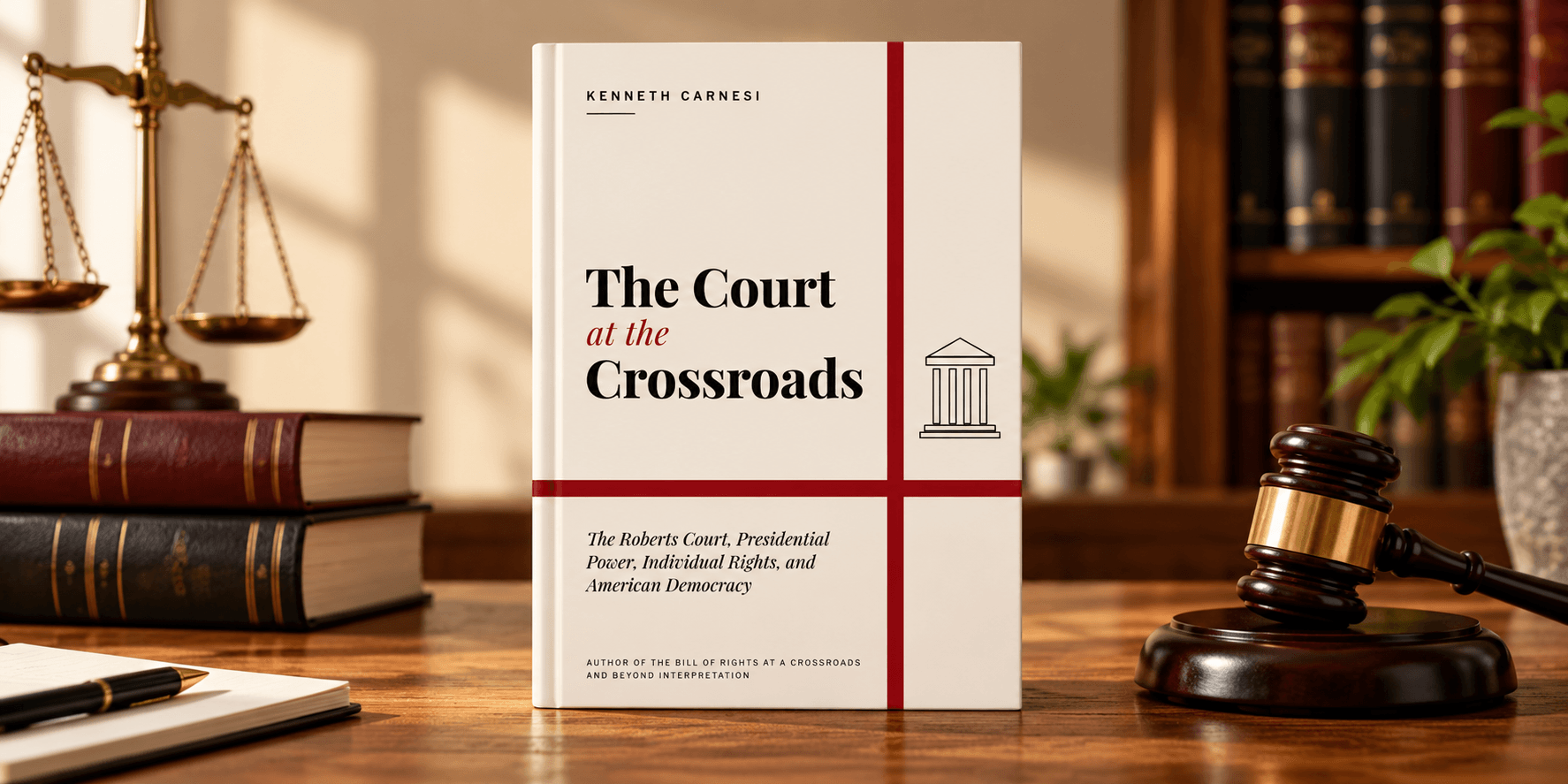
In his book, The Court at the Crossroads: The Roberts Court, Presidential Power, Individual Rights, and American Democracy, author Kenneth Carnesi offers a different approach to examining the nation's highest court. Instead of encouraging readers to adopt a particular political position, Carnesi invites them to understand how judicial decisions are reached, why competing interpretations matter, and what those decisions mean beyond the courtroom.
Published in 2026 and listed through Barnes & Noble under ISBN 9798908584777, the book examines two decades of Supreme Court decisions under Chief Justice John Roberts. Across sixteen chapters, Carnesi explores a central question: When the Supreme Court redraws the boundaries of constitutional power, who ultimately governs?
Kenneth Carnesi Offers A Different Perspective On The Roberts Court
What distinguishes The Court at the Crossroads from many books about the Supreme Court is its commitment to presenting legal reasoning without political advocacy.
Carnesi recognizes that readers may strongly agree or disagree with individual rulings. However, he argues that understanding a decision requires examining the constitutional principles and judicial arguments behind it.
“A decision can be carefully reasoned and still be one you oppose. A decision you cheer can rest on thin reasoning,” Carnesi writes.
This philosophy guides the book's examination of majority opinions, dissenting arguments, and historical precedents. Rather than telling readers which interpretation to accept, Carnesi provides the context needed to evaluate competing positions independently.
A review titled Book Review: The Court at the Crossroads describes the work as a clear, evenhanded, and deeply informed study of the Roberts Court. Its verdict emphasizes that the book respects readers enough to allow them to reach their own conclusions.
Each chapter follows a consistent structure, beginning with a legal dispute and its ruling before exploring judicial reasoning, historical background, and practical consequences. This approach helps readers understand complex constitutional questions without requiring extensive legal training.
How Supreme Court Decisions Shape Everyday American Life
Although Supreme Court decisions often involve technical legal arguments, their consequences can extend into everyday experiences.
Carnesi examines presidential authority through cases such as Trump v. United States (2024), which addressed presidential immunity for official conduct. He also explores the separation of powers and the constitutional limits placed on government institutions.
Federal regulatory authority receives attention through Loper Bright Enterprises v. Raimondo, the decision that overturned the longstanding Chevron framework for judicial deference to federal agencies' interpretations of ambiguous statutes.
Individual freedoms form another major part of the discussion. The book explores freedom of speech, digital privacy, religious expression, firearm regulations, and constitutional questions following Dobbs v. Jackson Women's Health Organization.
Carnesi also examines Second Amendment decisions, including District of Columbia v. Heller, New York State Rifle & Pistol Association v. Bruen, and United States v. Rahimi.
Beyond individual rights, the book addresses voting rights, electoral district boundaries, equal protection, and the Court's role in disputes involving democratic institutions.
By connecting these decisions to their practical consequences, Carnesi illustrates how constitutional interpretation influences the relationship between citizens and government.
Why Constitutional History Remains Essential To Understanding Modern Rulings
One of the book's strongest themes is that contemporary constitutional disputes often revisit questions that have challenged American government for generations.
Carnesi traces judicial review to Marbury v. Madison and examines presidential authority through historical decisions such as Youngstown Sheet & Tube Co. v. Sawyer and United States v. Nixon.
He also discusses Plessy v. Ferguson, Lochner v. New York, and Korematsu v. United States as reminders that Supreme Court interpretations can change and that judicial precedent remains subject to examination.
The book follows changes in the Court's composition during the Roberts era, including the transition from closely divided decisions associated with Justice Anthony Kennedy's tenure to a Court with a six to three conservative majority.
Throughout this historical examination, Carnesi identifies four enduring constitutional tensions: liberty versus regulation, federal versus state authority, precedent versus change, and judicial independence versus accountability.
These themes help readers recognize that Supreme Court decisions are part of an ongoing constitutional conversation rather than isolated legal events.
A Book Review Recognizes The Value Of Balanced Legal Analysis
A review of The Court at the Crossroads identifies Carnesi's refusal to take a political side as one of the book's defining strengths.
The review praises his treatment of controversial decisions involving abortion, firearm regulations, presidential authority, voting rights, and judicial ethics. It highlights the attention given to competing legal arguments and the absence of editorializing.
Its central assessment describes the book as a rare Supreme Court study that allows readers to form their own conclusions.
The review also recognizes the book's accessible explanations of legal concepts such as precedent and judicial review. These explanations make the material relevant to attorneys, law students, educators, journalists, civic leaders, and citizens seeking a deeper understanding of constitutional government.
Carnesi explains that his goal is to help readers “read a new Supreme Court decision, find its main argument and see what it changes and what it leaves open.”
That objective reflects the book's emphasis on developing informed readers rather than promoting predetermined conclusions.
Kenneth Carnesi Brings A Broader Writing Perspective To Constitutional Commentary
Kenneth Carnesi, Sr., serves as Chief Operating Officer of Anaptyx MSP and is the founder of the Anaptyx CivicConnect™ dedicated BEAD Program team.
Alongside his professional responsibilities, Carnesi has written about public policy, business, inspirational subjects, and constitutional issues.
His previous works include BEAD: Unlocking the Future, Collateral Courage, After The Fall, and Unfinished Business.
His related publication, The Bill of Rights At A Crossroads, examines how constitutional protections have evolved through judicial interpretation, technological developments, and changing national circumstances.
While that work focuses on the first ten amendments, The Court at the Crossroads examines the broader influence of Supreme Court decisions on presidential power, federal institutions, individual rights, and American democracy.
Together, these subjects reflect Carnesi's interest in making complex legal and institutional questions accessible through history, structured analysis, and practical examples.
Explore The Decisions Behind The Future Of Constitutional Government
Supreme Court rulings rarely end the constitutional questions they address. Instead, they often establish principles that influence future disputes, government decisions, and public understanding.
The Court at the Crossroads provides readers with a structured examination of those developments, combining historical context, judicial reasoning, and competing legal perspectives.
Readers interested in exploring the publication and discovering more of Carnesi's work can visit Kenneth Carnesi's official book collection or learn more about his publications and professional background through the Kenneth Carnesi official author website. The book is also listed through Barnes & Noble under ISBN 9798908584777.
For readers seeking more than headlines, Kenneth Carnesi's latest work offers an opportunity to understand how Supreme Court decisions are made, what they change, and why the reasoning behind them matters.

Today’s Read Contributor
Harriet Nyong'o
Covers authors and their working lives, profiling the writers behind the year's most discussed books.
This article features partner, contributor, or branded content from a third party. Members of the Today’s Read editorial staff were not involved in the creation of this content. All views and opinions are those of the contributor alone.
Readers Port: A New Home for Readers and Authors