
How One Book Challenges Humanity To Rethink Civilization Before Reaching The Stars
An ambitious philosophical work by Kaikhan Salakhov explores consciousness, civilization, and the future of humanity through art and cosmological thought.
There is a growing conversation about humanity’s future beyond Earth. Governments are planning lunar missions, private companies are pursuing interplanetary travel, and scientists continue searching for signs of intelligent life elsewhere in the universe. Yet amid these technological ambitions, one question receives far less attention: Our technology has already reached the stars, but has the consciousness directing it evolved beyond the egocentric, ethnocentric, and tribalistic patterns that define the very dysfunctions we would carry with us?
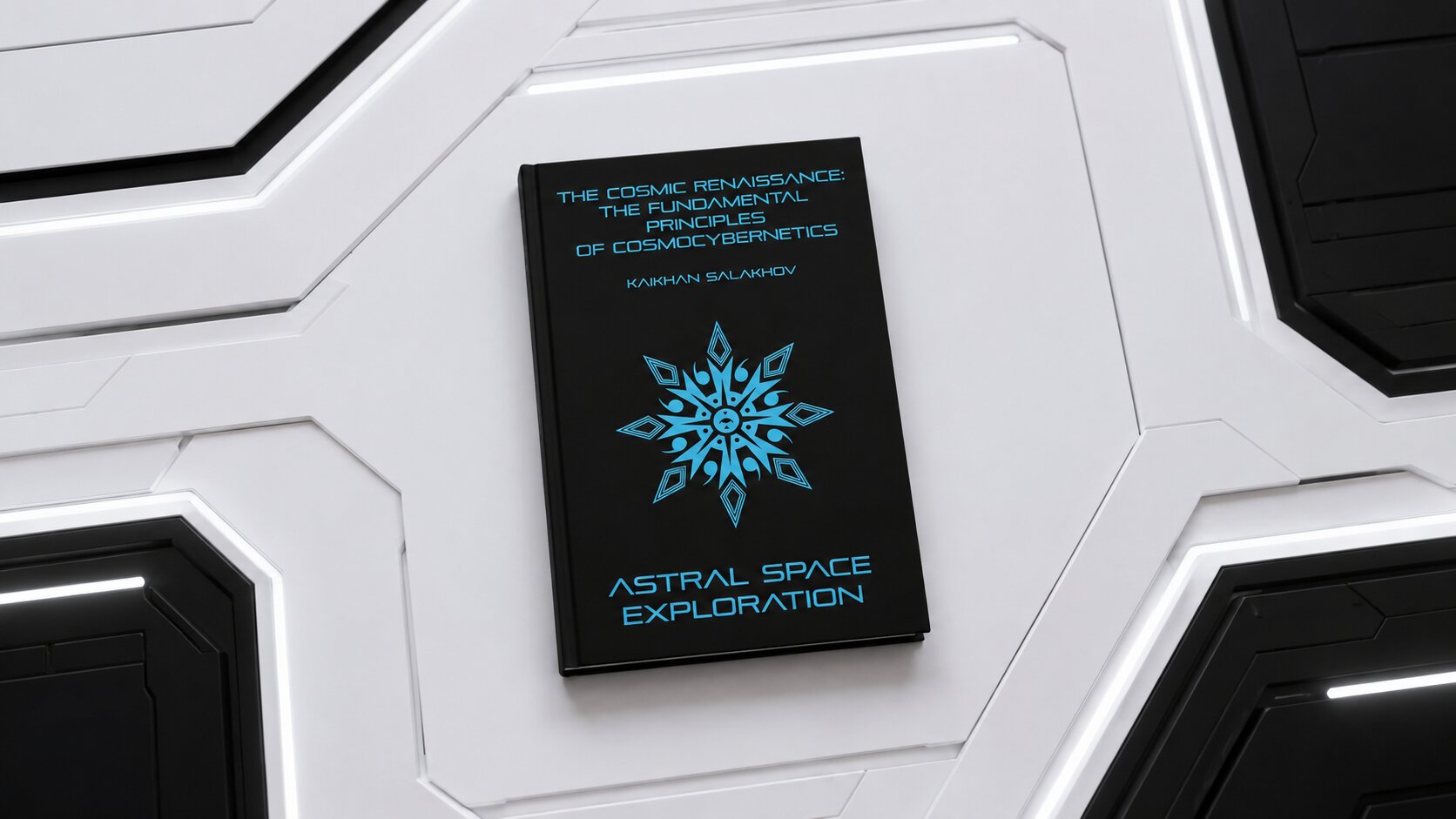
That question sits at the heart of Astral Space Exploration: The Cosmic Renaissance: The Fundamental Principles of Cosmocybernetics, an 852-page philosophical treatise by multidisciplinary artist and independent thinker Kaikhan Salakhov. Developed over seven years alongside a collection of thirty-six handmade paintings, the book presents a comprehensive intellectual framework examining the relationship between consciousness, technological progress, ethics, and interstellar expansion.
Rather than offering predictions about the future, the work invites readers to reconsider the assumptions that shape modern ideas of progress. Its argument is precise: scientific achievement alone cannot define the advancement of a civilization if questions of awareness, morality, and responsibility remain unaddressed. Progress cannot be reduced to its external expression alone. Without accounting for the depth and structure of the consciousness that operates behind every technological achievement, what is called progress becomes nothing more than the amplification of a Blind Horizon, one that sees only the material and the technological while remaining silent on what humanity carries within itself as it moves elsewhere into space.
Where Philosophy, Art, And Space Exploration Meet
Unlike traditional works of science fiction or academic philosophy, Astral Space Exploration: The Cosmic Renaissance occupies a deliberate space between disciplines and treats that position not as a compromise but as a methodological necessity. The questions it addresses cross boundaries that no single field was designed to hold: physics and ethics, biology and spirituality, systems theory and art history.
The project consists of two inseparable components. The book provides philosophical architecture, while a 2024 solo exhibition in Dubai presented thirty-six geometric paintings that visually express the concepts developed throughout the text. Created entirely by hand using canvas, oil and acrylics, ruler, and compass, the paintings reflect the project’s emphasis on deliberate craftsmanship in an age increasingly shaped by automation and generative systems. The choice is conceptual rather than stylistic: in a body of work that critically examines humanity’s relationship to its own technology, the act of making remains anchored in physical intention and sustained human attention.
Together, the written and visual works form a single investigation into how civilizations evolve, not only through technology, but through culture, spirituality, biology, and consciousness, understood as interdependent dimensions of a single developmental process.
A Different Way To Think About Civilizations
[IMAGE: https://todaysread.com/wp-content/uploads/2026/07/download-1-1-1024x512.jpg]
One of the book’s most distinctive contributions is the introduction of the ASX Grid, a multidimensional framework designed to examine civilizations through far more than technological achievement alone.
For decades, discussions about advanced civilizations have centered on measurable capability such as energy consumption, engineering capacity, and spatial reach. Salakhov argues that these measurements reveal what civilizations are capable of doing but say little about the quality of awareness guiding those capabilities. Two societies could hold identical technological power while embodying entirely different relationships to ethics, meaning, and other forms of life. A framework that registers them as equivalent is not neutral. It is blind in precisely the dimension where the most consequential differences reside.
The ASX Grid approaches development from multiple interconnected perspectives: technological growth, consciousness, biological evolution, economic systems, cultural transformation, spiritual development, and environmental adaptation. Rather than treating these as isolated categories, the framework presents them as parts of a larger system in which every dimension influences the others. A change in a civilization’s dominant mode of cognition reshapes its technology; environmental adaptation reshapes biology, and biology reshapes perception; economic structures themselves are direct reflections of the consciousness operating them. Development, in this model, is not a line to be climbed but a system in continuous, mutual reconfiguration.
The central proposition is simple yet expansive. A civilization’s greatest challenge may not be building more powerful technology, but developing the wisdom required to use that power responsibly. Technological capability accumulates through competition and incentive; it grows whether or not anyone intends it to. Wisdom does not. It requires deliberate cultivation and no dominant model of progress currently measures whether that cultivation is occurring. The imbalance between these two curves, in Salakhov’s analysis, defines the genuine risk of the coming century.
Asking Difficult Questions Instead Of Offering Easy Answers
Instead of presenting fixed conclusions, the book is structured around philosophical inquiry and its questions are grounded in the physical realities of interstellar existence rather than in speculation.
How might human identity change after centuries of adaptation to different planetary environments, as gravity, radiation, and atmosphere gradually reshape bodies, senses, and perception across generations? Can societies separated by light-years maintain shared values when communication itself takes decades, and every ethical disagreement must be negotiated across gaps longer than a human life? Would future civilizations become divided by biology, by technology, or by entirely different understandings of consciousness, divisions that begin as preferences and harden, over time, into incompatible forms of existence? And if intelligent nonhuman life exists, would humanity even possess the conceptual tools necessary to recognize it, let alone understand it?
These questions extend beyond speculative fiction because their premises are not speculative. The speed of light, the timescales of biological adaptation, and the dynamics of cultural divergence under isolation are established realities. What has been missing is a framework willing to follow those realities to their civilizational conclusions. The book encourages readers to confront the social, ethical, and philosophical consequences of long-term space exploration before those consequences arrive as accomplished facts, because by then, the window in which they could have been shaped will have closed.
Beyond A Human Centered View Of The Cosmos
Another defining aspect of the book is its rejection of strictly human-centered models of intelligence, a rejection that operates at the level of structure, not sentiment.
Rather than assuming humanity represents the standard by which every civilization should be measured, the work explores the possibility that entirely different forms of consciousness may emerge through biological evolution, synthetic intelligence, hybrid life forms, or extraterrestrial origins. The underlying logic is rigorous: perception is conditioned by biological composition, by the number and nature of an organism’s senses, by the organization of its cognition, by whether it experiences anything resembling a self. A form of awareness built on a different substrate would not simply see the universe differently. It would inhabit a different universe of meaning altogether. Any framework calibrated exclusively to human perception can recognize only what resembles it, and will misclassify or entirely fail to register everything that does not.
This broader perspective positions the project as an exploration of sentient development itself, expanding the conversation beyond human history into a much larger cosmological context. By questioning assumptions that often go unchallenged, such as that intelligence looks like ours, that progress means expansion, and that consciousness is singular in kind, the book encourages readers to imagine futures that extend beyond familiar political, cultural, and biological boundaries, and to notice how quietly those boundaries have constrained the entire conversation until now.
Seven Years Of Interdisciplinary Exploration
The scale of the project reflects its ambition. Over seven years, Kaikhan Salakhov combined influences from architecture, philosophy, systems thinking, Renaissance art, speculative fiction, and consciousness studies to develop a body of work that resists traditional classification.
The result is neither purely philosophical nor purely artistic. It is an interdisciplinary investigation into some of humanity’s oldest questions about identity, evolution, purpose, and our place within the universe, conducted with the structural discipline of architectural training and the freedom of a thinker working outside institutional constraint. That independence is not incidental to the outcome. The framework connects domains that formal disciplines typically keep separate, and it introduces a proposition that has not previously existed within space exploration discourse: that consciousness, not capability, should serve as the organizing axis of civilizational development.
As conversations surrounding artificial intelligence, transhumanism, and space exploration continue to accelerate, the book offers a timely counterargument to the prevailing narrative: technological capability alone may never define genuine progress, and a civilization’s trajectory is ultimately determined not by what it builds, but by the awareness with which it builds.
A Conversation About Humanity’s Future
Readers, collectors, and thinkers interested in Astral Space Exploration: Cosmocybernetics can explore the full project through its official platform at astralspacex.com. The complete book is available via Amazon. The exhibition and gallery representation can be explored through Gallery: Firetti Contemporary
Further insight into the artistic philosophy and process appears in a published feature at hube magazine interview, and ongoing updates can be followed through the artist’s official Instagram.

Today’s Read Contributor
Harriet Nyong'o
Covers authors and their working lives, profiling the writers behind the year's most discussed books.
This article features partner, contributor, or branded content from a third party. Members of the Today’s Read editorial staff were not involved in the creation of this content. All views and opinions are those of the contributor alone.